Associated Testing Laboratories


Geotechnical investigation
A geotechnical investigation is the process of collecting and analyzing information about the physical properties of soil, rock, and subsurface conditions at a specific site to assess

Pile Foundation Totaly
A pile foundation is a type of deep foundation that is used to transfer the load of a structure through weak or unstable soil layers to deeper, stronger, and more stable soil or rock strata.

NDT Non Destructive Testing
Non-Destructive Testing (NDT) is a method of inspecting, testing, or evaluating materials, components, or structures without causing any damage to them.
Rebound Hammer
A Rebound Hammer, also known as the Schmidt Hammer, is a non-destructive testing (NDT) device used to measure the surface hardness of concrete, which helps in estimating its compressive strength.
Carbonation
Carbonation is a chemical process in which carbon dioxide (CO₂) from the air reacts with calcium hydroxide (Ca(OH)₂) in hardened concrete to form calcium carbonate (CaCO₃).
Half cell potential test
The Half-Cell Potential Test is a non-destructive test (NDT) used to assess the likelihood of corrosion in the steel reinforcement within reinforced concrete structures.
Ultrasonic pulse velocity
The Ultrasonic Pulse Velocity (UPV) Test is a non-destructive testing (NDT) method used to evaluate the quality, uniformity, and integrity of concrete by measuring the speed of an ultrasonic pulse passing through it.
Pile integrity test
The Pile Integrity Test (PIT), also known as the Low Strain Integrity Test, is a non-destructive testing (NDT) method used to evaluate the structural soundness and continuity of piles.
Pile foundation
A Pile Foundation is a type of deep foundation that is used to transfer the load of a structure to deeper, stronger soil or rock layers when the surface soil is too weak to support the structure.
Cross hole sonic logging
Cross Hole Sonic Logging (CSL) is a non-destructive testing (NDT) method used to evaluate the integrity and quality of deep concrete foundations, such as drilled shafts or piles.
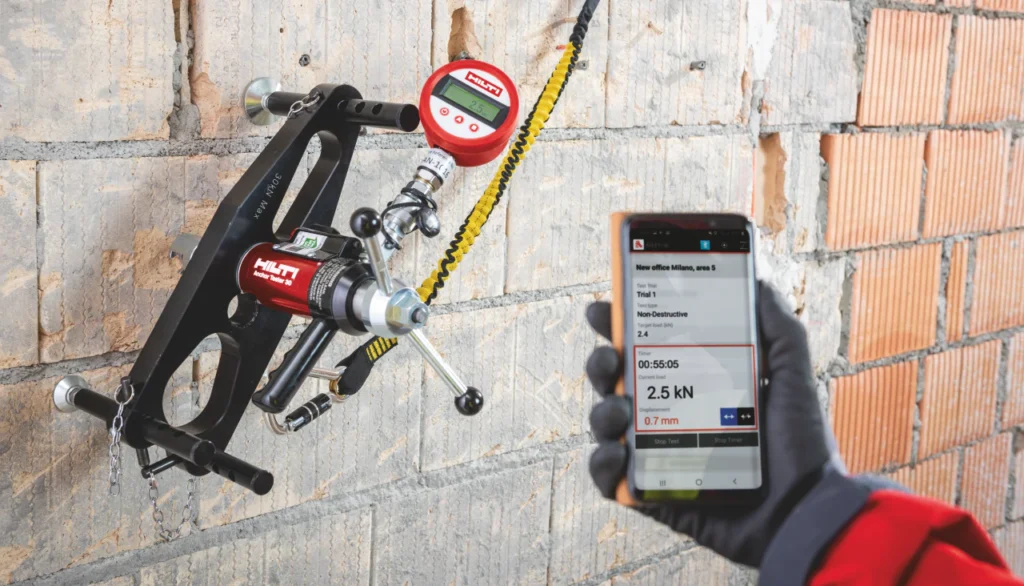
Anchor Testing
Anchor Testing is a field test used to determine the load-carrying capacity, performance, and reliability of anchors (such as bolts, rods, or piles) that are fixed into concrete, rock, or soil.
Uplift Test
An Uplift Test is a field test used to determine the uplift (tensile) load capacity of a foundation element such as a pile, anchor, or footing that resists upward forces.
Vertical load test
A Vertical Load Test is a field test conducted to determine the load-carrying capacity and settlement behavior of a pile or foundation when subjected to vertical (downward) loads.
Lateral load test
A Lateral Load Test is a field test conducted to determine the behavior and load-carrying capacity of a pile or foundation when subjected to horizontal (sideways) loads.