Associated Testing Laboratories

Carbonation
Carbonation
Introduction
Carbonation is one of the most common causes of reinforcement corrosion in concrete structures.
When carbon dioxide (CO₂) from the atmosphere penetrates concrete, it reacts with calcium hydroxide and reduces the concrete’s alkalinity — creating conditions that allow steel reinforcement to corrode.
At ASSOCIATED TESTING LABORATORIES, we provide accurate and reliable Carbonation Testing to assess the depth of carbonation and determine the durability and remaining life of concrete structures.
What is Carbonation in Concrete?
Carbonation is a chemical reaction between carbon dioxide in the air and the hydrated cement compounds inside concrete.
This reaction lowers the pH of concrete from around 12.5 to below 9, reducing its natural protection against steel corrosion.
As carbonation progresses deeper into the concrete, it can eventually reach the reinforcement, leading to:
Corrosion of steel
Cracking and spalling
Reduction in structural strength
Long-term deterioration
Why is Carbonation Testing Important?
Carbonation testing helps identify:
Whether reinforcement is at risk of corrosion
The rate and extent of deterioration
Durability and life expectancy of concrete
Need for repair, rehabilitation, or protective coatings
Quality of concrete in old and exposed structures
How Carbonation Test is Done
We perform carbonation testing as per IS 516, IS 1193, and standard global procedures.
Testing Procedure:
A small freshly exposed surface of concrete is prepared using drilling or breaking.
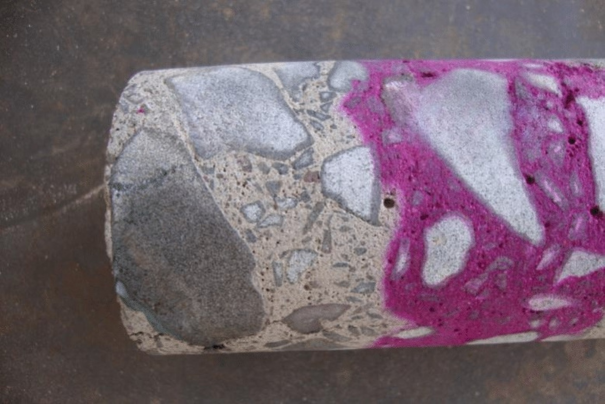
A 1% phenolphthalein indicator solution is sprayed on the surface.
The solution colors non-carbonated concrete (alkaline) to pink.
Carbonated concrete remains colorless.
The depth of the colorless layer is measured as carbonation depth.
Factors Influencing Carbonation
Our reports consider key factors such as:
Concrete quality and strength
Water–cement ratio
Age of the structure
Exposure to rain, humidity, and CO₂ levels
Cracks or poor cover
Surface finishing
This ensures accurate interpretation and suitable recommendations.
Applications of Carbonation Test
Carbonation testing is widely used for:
Structural audits
Repair and rehabilitation planning
Bridges, buildings, tunnels, and flyovers
Old concrete structures
Coastal and industrial environments
Quality evaluation of existing concrete
Benefits of Carbonation Testing
Detects early signs of corrosion risk
Assesses concrete durability
Helps plan maintenance and repair
Cost-effective and simple testing method
Provides clear visual results
Our Carbonation Testing Services
At ASSOCIATED TESTING LABORATORIES, we offer:
On-site carbonation depth testing
Advanced structural audit services
Combined assessment with Half Cell Potential, UPV & Rebound Hammer
Detailed technical reporting with expert recommendations
Compliance with IS, ASTM, and BS standards
Why Choose Us?
Certified NDT & structural engineers
Accurate testing with standard procedures
Fast reporting with detailed analysis
Modern equipment and professional team
Affordable, reliable & high-quality service
Our Services
Get in Touch with us
Cost Effective Great Quality
Through smart planning, skilled execution, and efficient resource management, we provide services that maintain outstanding quality while keeping costs under control. Our approach guarantees that every project delivers durability, precision, and value without compromise.
